Most Lake Eufaula buyers walk a shoreline. Carlton Landing buyers walk a contract.
The lake has over 800 miles of shoreline and roughly 260 subdivisions around it, and the vast majority of them let an owner build almost anything a septic engineer will sign off on. Carlton Landing does the opposite. What looks, from the sidewalk, like a design sensibility is actually a legal and administrative apparatus. Buyers who understand it before they write an offer tend to enjoy what it protects. Buyers who discover it after closing tend to feel it as friction.
This is a post about that trade.
The contract you sign without reading it
Carlton Landing is not a subdivision inside a county. It is a town. It is a master-planned resort town in Pittsburg County established on October 21, 2013, with a population of 94 as of 2020. It is also the first new urban town in the US to be legally incorporated, which matters because incorporation gives the community regulatory tools most lakefront developments never have.
The town plan came from DPZ CoDESIGN, the firm Andres Duany co-founded. Carlton Landing was conceived by developer Grant Humphreys, son of former Oklahoma City Mayor Kirk Humphreys, inspired by visits to Seaside, Florida, one of the first communities designed according to the tenets of New Urbanism; his family had vacationed on Lake Eufaula since 1971. The Humphreys Company began purchasing land adjacent to the lake in 2007, acquired approximately 1,600 acres within 12 months, and then contracted with urban planners, architects, and engineers to design a pedestrian-centric neighborhood with lots for 2,000 homes.
Humphreys has been direct about why the design controls exist:
"We believed if there was a place that involved good urbanism, good architecture and a high level of resort services and community programming, and some assurance on the investment through design controls; if we could bring that all together, it would work on this site."
Read that sentence twice. Design controls are pitched as investment assurance, not as taste. That is the economic argument the whole community rests on.
What the pattern book actually specifies
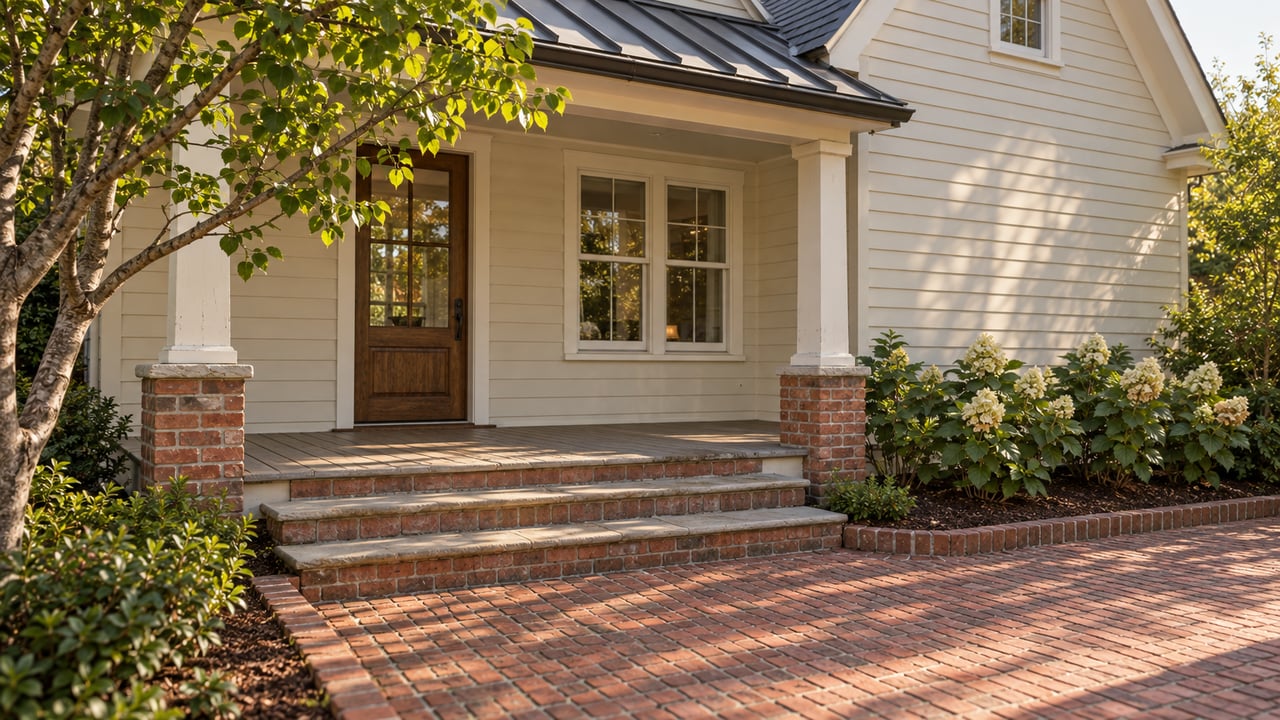
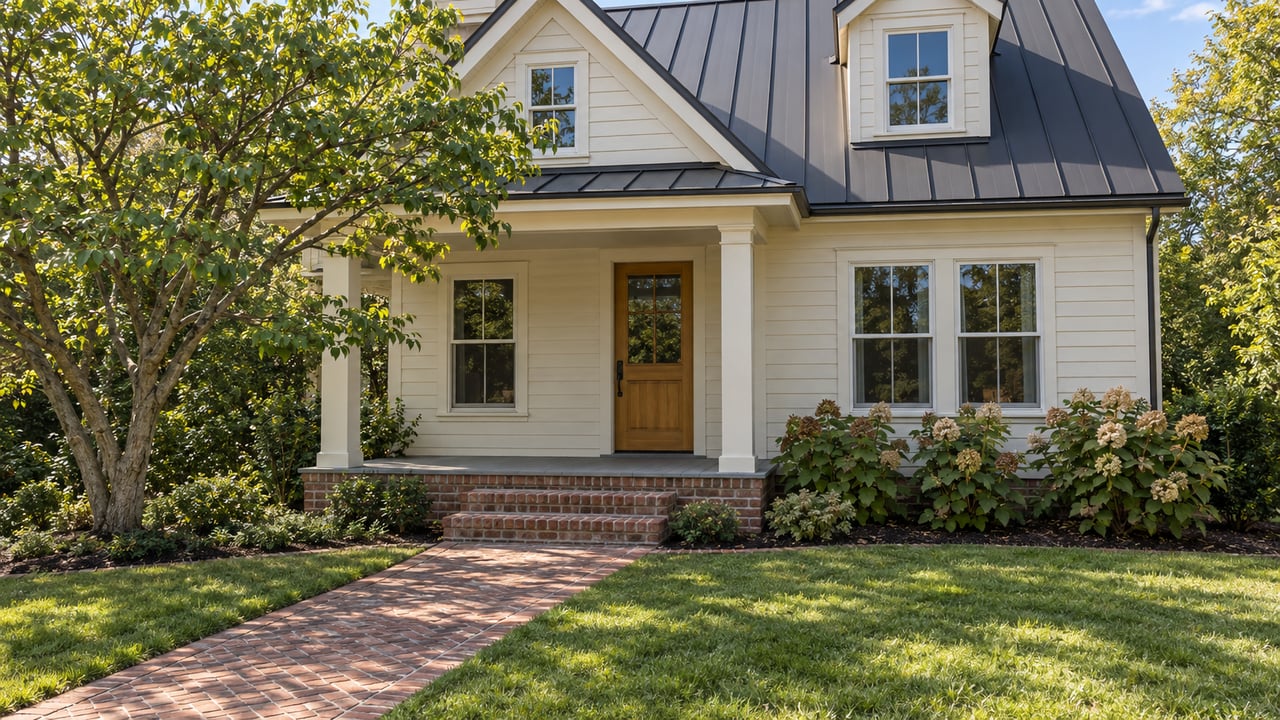
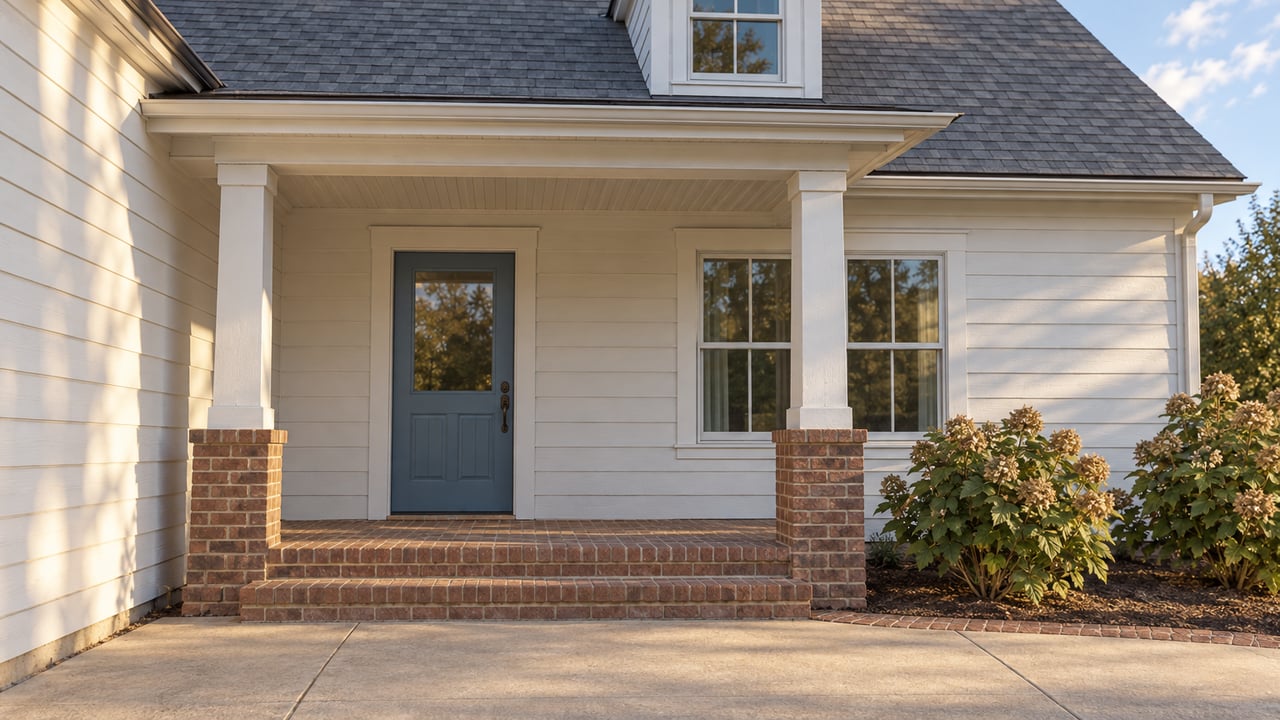
Design controls in Carlton Landing operate through a pattern book and an architectural review process. The pattern book sets vocabulary. The architecture employs rural Oklahoma vernacular styles in wood clapboard and board and batten siding, with a consistent standing-seam metal roofscape that will protect buildings for many generations and give the town a unique look. The rooflines are not a suggestion. Neither is the siding.
Allison Ramsey Architects contributes an approved-plan catalog. In 2008 the firm collaborated with Andres Duany and his charrette team to design Carlton Landing, the first recent New Urbanist community to become an incorporated town. Their Carlton Landing Collection publishes specific homes buyers can license and build: a 1,735 square foot plan with three bedrooms, two-and-a-half bathrooms, and a 422 square foot covered porch; the 2,432 square foot Cassatt Cottage with a 173 square foot screened porch and a 298 square foot covered porch; and the 2,049 square foot Ames II with three bedrooms and three bathrooms. Buyers can also work with a builder to design something custom, but the reviewers still hold the pattern book.
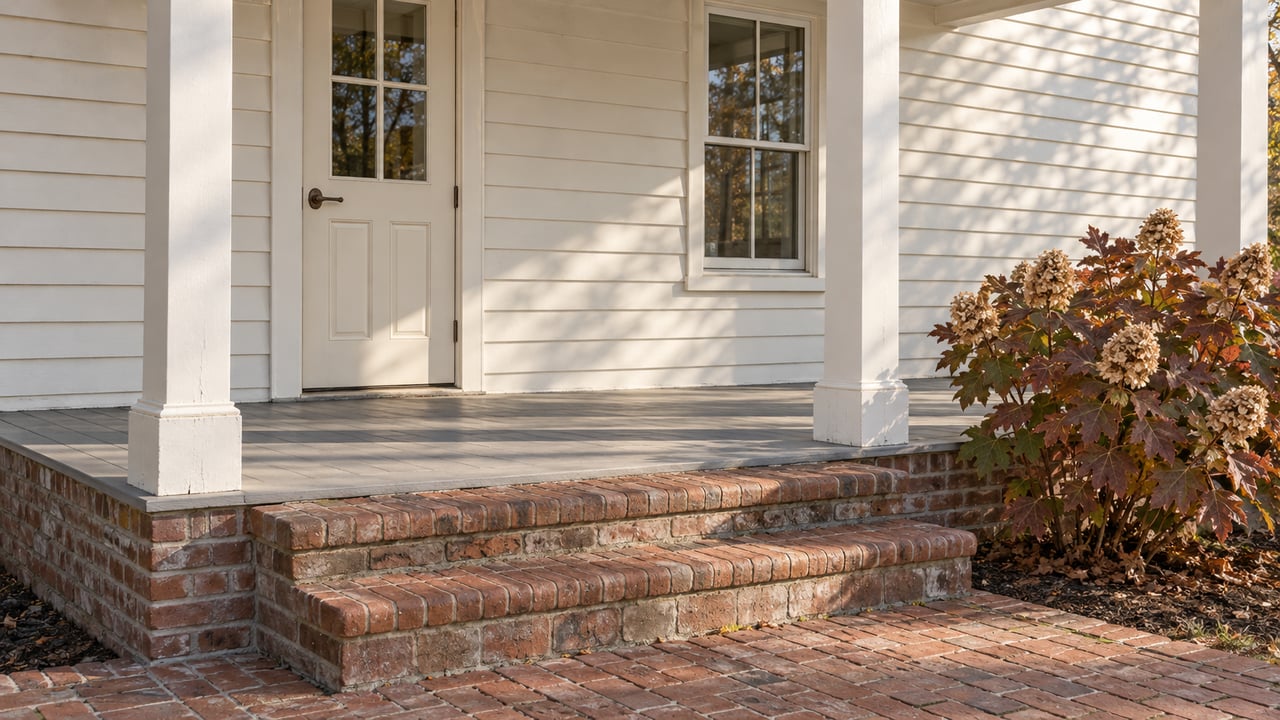
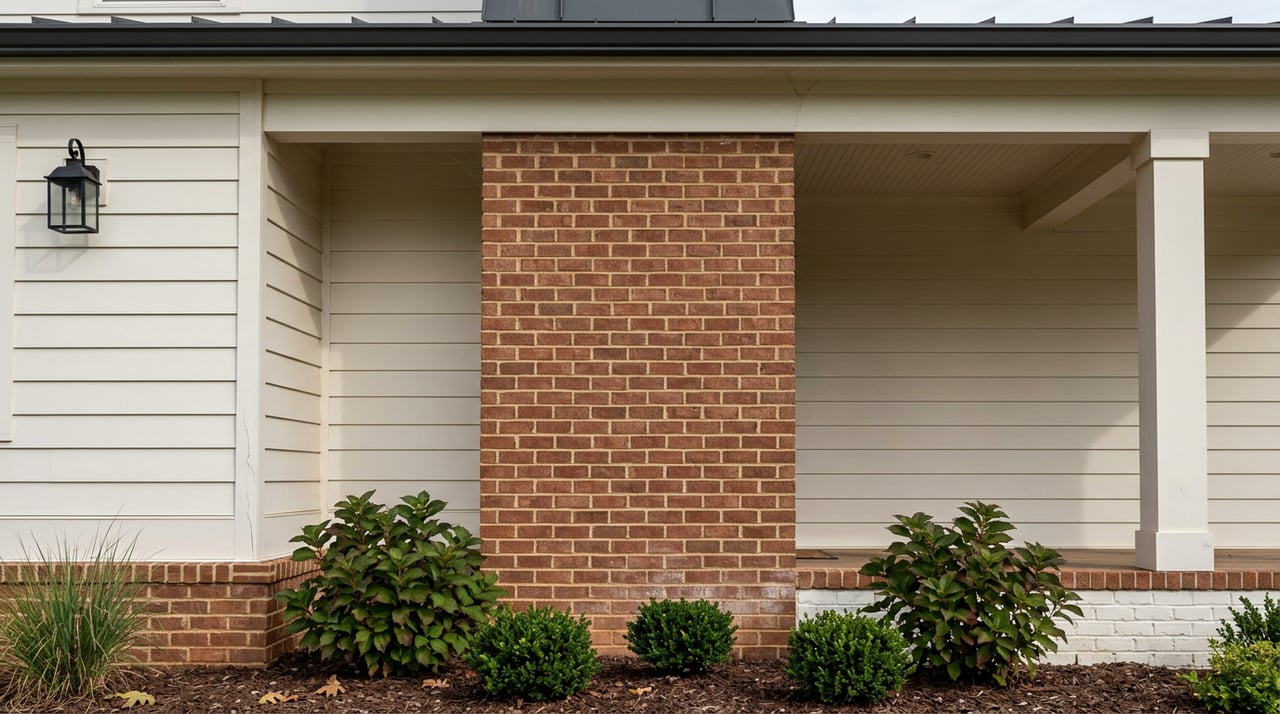
Then there is the outlier work. Clay Chapman has built 18 structural clay-brick homes with foot-thick brick-and-mortar walls in the town, competing against modern wood-frame construction; among his projects is The Borough, eight structural brick cottages grouped around a common court. Chapman believes the exterior walls and foundation of these houses could last 30 generations, and describes the work as pre-War, common-bond, structural, load-bearing, triple-wide clay brick masonry. Chapman himself explains why he brought that method here: getting brick mass-wall houses approved through conservative building departments is a hassle, so Carlton Landing, the first new urban town that is its own municipality, was attractive.
That is the pattern, then. A town willing to approve unusual quality, unwilling to approve the ordinary.
The renovation friction most buyers don't price in
Here is the part buyers routinely miss until they own the house.
Changing an exterior element in a design-controlled community is not a matter of hiring a contractor. It requires submitting plans to an architectural review body, waiting through a review window, and living with whatever the reviewers write back. That applies to paint colors, porch modifications, fencing, window replacements, landscaping visible from the street, garage placement, and roofing. It applies whether the house is new construction, a resale, or a lot you have owned for a decade.
Two consequences follow. The first is time. A renovation that would take four weeks in a conventional Lake Eufaula subdivision can take longer here, because submission and review sit in front of the contractor's schedule. The second is scope. Some ideas that make sense on Pinterest do not make sense inside the pattern book. Reviewers will tell you which ones, and their answer is the one that governs.
For most buyers the trade is worth it. For a few it is not. The right time to figure out which category you are in is before the offer, not after.
| Consideration | Typical Lake Eufaula subdivision | Carlton Landing |
|---|---|---|
| Exterior material choice | Owner's discretion, subject to county code | Governed by pattern book |
| Roof profile and color | Owner's discretion | Standing-seam metal, coordinated palette |
| Front-facing modifications | Rarely reviewed | Submitted to architectural review |
| Resale visual coherence | Depends on neighbors | Protected by ongoing enforcement |
| Approval timeline for exterior changes | Contractor's schedule | Review window plus contractor's schedule |
Infrastructure is part of the same contract
Design controls only work when the town behind them functions. Carlton Landing's infrastructure story is mostly a strength, with one instructive chapter.
Launched during the Great Recession in 2009, Carlton Landing took a "light imprint" approach to stormwater infrastructure that has saved millions of dollars in development costs while sustainably filtering rainwater without piping, using less pavement and creating features like the town's boardwalk pedestrian paths. That is the strength: less impervious surface, cleaner runoff into the lake, and a distinctive pedestrian network that has become part of what buyers pay for.
The instructive chapter concerns wastewater. In June 2019, the town water district was fined $100,000 by the Oklahoma Department of Environmental Quality for repeatedly discharging wastewater without first obtaining approvals from the DEQ, after the water district discharged millions of gallons of partially treated wastewater into Lake Eufaula between March 2018 and June 2019. Humphreys promised that the town would build a water treatment plant capable of handling 80,000 to 160,000 US gallons a day, versus the earlier 18,000 US gallons per day capacity. A buyer researching the town today should ask where that capacity now stands and how it maps to the current build-out plan. It is a fair question and the town's leadership is used to it.
What this means when you resell
The economic case for design controls hinges on resale. A pattern book without teeth produces a subdivision that looks great in year three and mixed in year fifteen. A pattern book with teeth produces a town where the fifteenth-year home still reads as part of a coherent place.
Two facts about Carlton Landing matter here. First, the build-out is deliberately long. The town, 20 percent built when catalogued by the Congress for the New Urbanism, is designed for more than 5,000 residents when complete in about 2040. That means an owner selling in 2028 or 2032 is selling into a market where the same design controls are still shaping new inventory next door. Coherence is not a memory of the original marketing; it is an ongoing act.
Second, the pattern book has room for genuinely distinctive product. A Clay Chapman brick cottage, an Allison Ramsey plan built with high specification, and a well-executed custom home all coexist inside the same rulebook. When a buyer's agent presents a home here, the design layer is part of the pricing story, not a footnote to it. Sellers who understand that layer market their homes accordingly. Sellers who ignore it tend to leave value on the table.
A short FAQ
Are Carlton Landing's design controls a homeowners association or a town rule? The town is incorporated, and the design layer sits alongside standard CC&R and architectural review structures used across master-planned communities. Any specific buyer should request the current governing documents before writing an offer.
Can I build a plan that isn't in the Allison Ramsey collection? Yes. Custom work is common. It goes through the same review process, and the pattern book acts as a reference rather than a hard menu.
How does the design layer interact with short-term rental use? Design controls govern the building. Rental policy is a separate question that has evolved as the town has grown. It should be researched at the time of purchase, because the answer changes.
Is the water and wastewater question resolved? The town committed to expanded treatment capacity after the 2019 DEQ action. A current-year status check with the town water district is a reasonable diligence step for any buyer.
If you are weighing Carlton Landing against another lakefront option, the design-control layer deserves as much diligence as the dock and the view. Katie Chapman & Co. lives inside that layer every day and can walk you through what it protects, what it costs, and where it leaves room. Reach out when you are ready to look past the shoreline and into the contract.